
By: Amy Orben, Tobias Dienlin, and Andrew K. Przybylski
May 21, 2019
Abstract
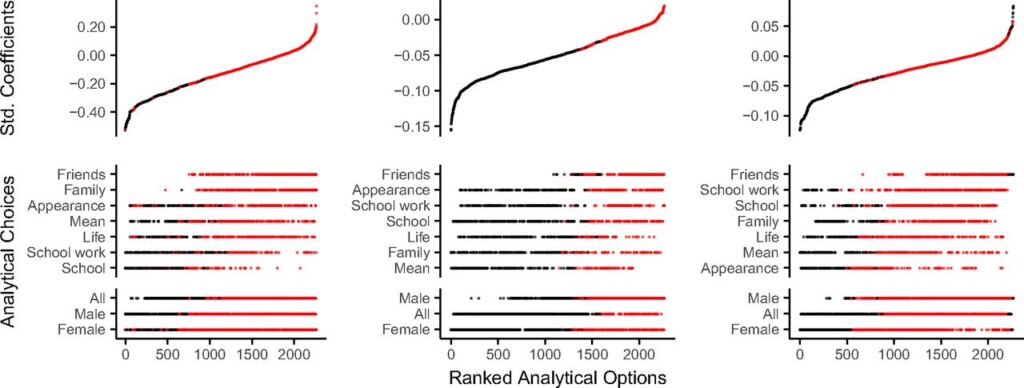
In this study, we used large-scale representative panel data to disentangle the between-person and within-person relations linking adolescent social media use and well-being. We found that social media use is not, in and of itself, a strong predictor of life satisfaction across the adolescent population. Instead, social media effects are nuanced, small at best, reciprocal over time, gender specific, and contingent on analytic methods.
social media adolescents life satisfaction longitudinal random-intercept cross-lagged panel models
Does the increasing amount of time adolescents devote to social media negatively affect their satisfaction with life? Set against the rapid pace of technological innovation, this simple question has grown into a pressing concern for scientists, caregivers, and policymakers. Research, however, has not kept pace (1). Focused on cross-sectional relations, scientists have few means of parsing longitudinal effects from artifacts introduced by common statistical modeling methodologies (2). Furthermore, the volume of data under analysis, paired with unchecked analytical flexibility, enables selective research reporting, biasing the literature toward statistically significant effects (3, 4). Nevertheless, trivial trends are routinely overinterpreted by those under increasing pressure to rapidly craft evidence-based policies.
Our understanding of social media effects is predominately shaped by analyses of cross-sectional associations between social media use measures and self-reported youth outcomes. Studies highlight modest negative correlations (3), but many of their conclusions are problematic. It is not tenable to assume that observations of between-person associations—comparing different people at the same time point—translate into within-person effects—tracking an individual, and what affects them, over time (2). Drawing this flawed inference risks misinforming the public or shaping policy on the basis of unsuitable evidence