
By: Joe Palca
October 23, 2019
Tiny satellites are taking on a big-time role in space exploration.
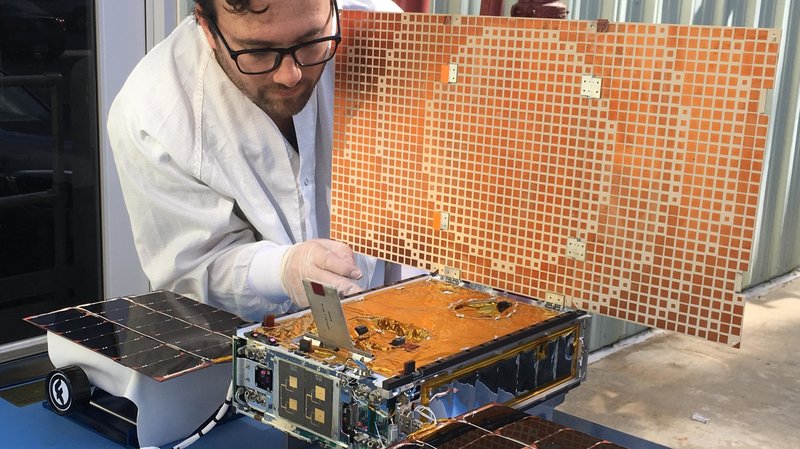
CubeSats are small, only about twice the size of a Rubik’s Cube. As the name suggests, they’re cube-shaped, 4 inches on each side, and weigh in at about 3 pounds. But with the miniaturization of electronics, it’s become possible to pack a sophisticated mission into a tiny package.
CubeSats have been around since 1999. Two professors, Jordi Puig-Suari from California Polytechnic State University and Bob Twiggs from Stanford University, wanted to standardize the design specifications of what they termed “picosatellites.” That would make it easier for teams of college students anywhere in the world to collaborate. What’s more, they were cheap enough that even students could make one.
“I saw a flyer on a bus stop that said, ‘Want to build a satellite?’ ” says Hannah Goldberg. At the time, in 1999, she was an undergraduate engineering major at the University of Michigan. The flyer caught her attention, and she decided that building satellites was exactly what she wanted to do.
Today, Goldberg works at GomSpace, a Danish satellite company making CubeSats for the European Space Agency.
“In the beginning, in the early days of CubeSats, they kind of had a bad reputation,” Goldberg says. “People didn’t think you could do much science or much engineering benefit with them.”