
By: Keith Bradsher
May 12, 2017
Even a decade ago, car manufacturing in China was still a fairly low-tech, labor-intensive endeavor. Thousands of workers in a factory, earning little more than $1 an hour, performed highly repetitive tasks, while just a handful of industrial robots dotted factory floors.
No longer.
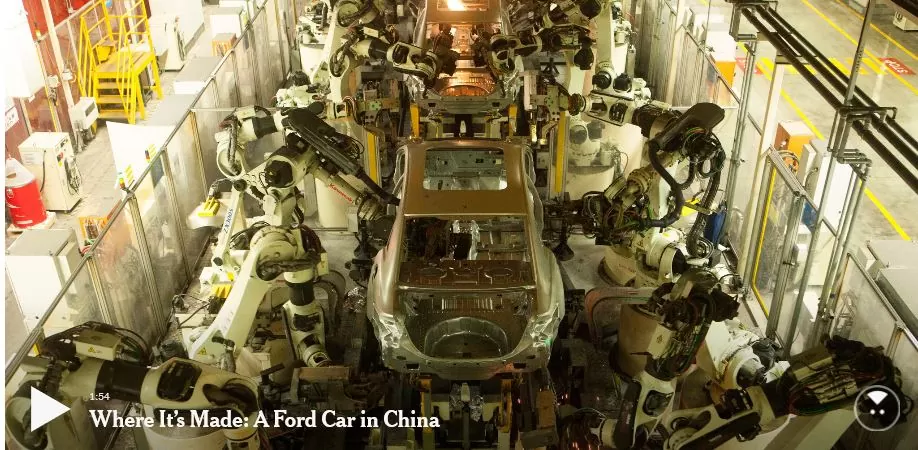
At Ford’s newest car assembly plant in Hangzhou in east-central China, at least 650 robots, resembling huge, white-necked vultures, bob and weave to assemble the steel structures of utility vehicles and midsize sedans. Workers in blue uniforms and helmets still do some of the welding, but much of the process has been automated.
Ford’s new factory is part of a widespread transformation of manufacturing in China, as automakers invest millions of dollars into what is now the worlds largest auto market. Carmakers increasing reliance on robots is due to both cost and the country’s changing work force. The one-child policy, which cut the birth rate through the 1980s and ’90s, in combination with an eightfold increase in college enrollments, has significantly cut the number of people entering the work force who have less than a high school degree and may be willing to work in a factory. Thus loss of jobs from automation is not a fear the Chinese share with the US. As more and more factories open, more workers will be needed to man those facilities and produce more cars. “Robots aren’t the threat,” Paul Buetow, the director of China manufacturing at General Motors told the Times. “The threat is not being able to run your business with products that people want to buy.”